 Ashley Elle
Pennsylvania does not lack ghost stories.
They collect in former prisons and poorhouses, in grand rooms built for parties that never happened, and across fields where thousands of men were killed or wounded in a matter of days. They travel through generations, acquiring new witnesses and details along the way. A noise becomes a footstep. A shadow becomes a soldier. An object discovered out of place becomes evidence that someone, or something, has returned.
The traditional haunted-history story asks one question: Do you believe?
A better question is why certain places become haunted in the public imagination while others do not. Ghost stories tend to settle where the historical record feels incomplete, where suffering was hidden from view or where official accounts fail to provide a satisfying conclusion. They give movement and personality to events that might otherwise be reduced to names, dates and numbers.
A ghost can turn a building back into a home. It can restore a person to an institution that once reduced them to a patient, prisoner, or casualty. It can also reveal what a community has not fully confronted about its own past.
Across Pennsylvania, the supernatural and the historical are closely intertwined. You do not have to accept every report of an apparition to recognize what these stories are trying to preserve.
Hill View Manor, New Castle
The long corridors of Hill View Manor were not originally designed to frighten visitors. They were built to contain a social problem. The facility opened in 1926 as the Lawrence County Home for the Aged, also known as the county poorhouse or poor farm.
Its residents included older adults, people with mental illnesses and those living in severe poverty. During the Great Depression, children were housed there as well. The people under its care were commonly called “inmates,” even though poverty, illness, and age were often the only reasons they had been placed inside.
The language reflected the philosophy of the time. Communities needed somewhere to send people who couldn’t work, live independently, or rely on family support. County institutions offered food and shelter, but they also removed vulnerable people from public view. Residents could spend years living within a system that controlled their movements, routines, and identities.
In 1977, the building was expanded and renamed Hill View Manor as it transitioned into a nursing home. It continued operating until 2004. By then, generations of residents and employees had passed through the property.
Today, Hill View Manor is one of Western Pennsylvania’s most recognizable paranormal destinations. Visitors have reported voices in empty rooms, figures appearing at the ends of hallways and the sound of footsteps moving through otherwise vacant sections of the building. Certain former residents have become recurring characters in its paranormal history, identified by names or personalities through repeated investigations.
It is easy to understand the building’s hold on the imagination. Institutional architecture has its own unsettling vocabulary: identical rooms, long sightlines, heavy doors and corridors designed for observation rather than comfort. Once emptied, such a building appears caught between uses. The furniture is gone, but the evidence of the former life remains hauntingly present.
The paranormal stories also provide something the institution itself did not always offer its residents: individuality. A reported spirit has preferences, habits and a name. Visitors enter hoping to encounter someone specific. People who were once categorized together as the aged, the mentally ill or the poor become distinct presences worthy of attention.
That does not prove anyone remains inside Hill View Manor. It does suggest that the desire to find them is connected to more than fear. The ghost hunt becomes an unconventional form of remembrance.
The Cathedral of Learning, Pittsburgh
The Cathedral of Learning looks like a place built to contain secrets.
Its limestone tower rises above Oakland with the scale and solemnity of a European monument. Inside, the Nationality and Heritage Rooms preserve architectural traditions from around the world, turning classrooms into carefully constructed encounters with other times and places.
Two rooms are particularly associated with the Cathedral’s supernatural reputation.
The Early American Room recreates a 17th-century New England home, complete with a low-beamed interior and an upstairs bedroom hidden behind the walls. That second level can be reached through a concealed passage, a feature practically engineered to produce whispered stories among generations of students.
Much of the reported activity centers on an antique wedding quilt donated by Martha Jane Poe McDaniel, a distant relative of Edgar Allan Poe. The quilt rests on a four-poster bed in the hidden room. According to campus lore, it does not always remain as it was arranged. Visitors and employees have also reported objects shifting, a cradle rocking without assistance, unexplained cold spots and the feeling that another person is present.
The Croghan-Schenley Ballroom carries a more personal story.
The ballroom was originally part of the mansion of William Croghan Jr. It was reportedly built for the social debut of his daughter, Mary. She never danced there.
At 15, Mary left for England and was married to 43-year-old British officer Captain Edward Schenley, in what has historically been described as an elopement. This created a family rupture that became part of Pittsburgh history.
The room was relocated to the Cathedral of Learning during the 1950s. Its preserved interior includes a false fireplace that opens into a small hidden chamber. Reports attached to the ballroom include furniture discovered out of place, a chandelier moving without an obvious cause, piano music with no visible player and an apparition believed to be Mary herself.
The documented history already contains nearly everything a Gothic tale requires: a wealthy family, a teenage heiress, a secretive and questionable marriage, an unused ballroom and a concealed space behind a fireplace.
The supernatural claims did not create the drama. They grew naturally around a story that already seemed unfinished.
The Cathedral is unusual among allegedly haunted places because its rooms were intentionally designed to carry history forward. Materials, furnishings and architectural elements were collected and preserved so that the past could remain physically present. The building does not merely contain old objects. It places them into reconstructed environments and invites each new generation to enter.
Under those conditions, an object moving from its assigned position feels more significant than it would elsewhere. A shifted quilt appears to reject its status as an artifact. A moving chandelier suggests that the ballroom is not finished waiting for its first dance.
The rooms blur the boundary between preservation and performance. They were built to make history feel occupied. Their ghost stories suggest the project may have succeeded too well.
The Handprint in Cell 17, Jim Thorpe
Inside the Old Jail Museum in Jim Thorpe, one mark has become more famous than the building that contains it.
A handprint remains visible on the wall of Cell 17. It is associated with Alexander Campbell, one of several men accused of belonging to the Molly Maguires and executed during the late 1870s.
The Molly Maguires have occupied an uncertain place in Pennsylvania history for nearly 150 years. They were said to be members of a secret Irish organization operating in the anthracite coal region, where miners endured dangerous working conditions, low wages and discrimination. The group was accused of intimidation, sabotage and murder. Mine owners portrayed its members as violent criminals. Labor historians have questioned whether the prosecutions were influenced by the coal companies’ power and a broader effort to weaken organized resistance among workers.
The investigations depended heavily on private operatives working for the Pinkerton National Detective Agency. The prosecutions that followed involved a troubling overlap between corporate interests and the criminal justice system. In several cases, coal and railroad interests participated in an extraordinary process that helped investigate, prosecute, and ultimately execute men viewed as threats to their authority.
Campbell maintained his innocence.
According to the story repeated at the jail, he pressed a dirty hand against the wall before his execution and declared that the mark would remain as proof that an innocent man had been condemned. Efforts to wash, paint or plaster over it supposedly failed. The handprint returned. There is no definitive way to prove how the mark was made or whether the familiar account unfolded exactly as it is now told. That uncertainty has not diminished its power.
The handprint compresses a complicated history of immigration, labor, industrial power and disputed justice into a single image. It is physical, immediate and difficult to ignore.
Visitors don’t need to understand every political and economic force operating in the coal region to understand the meaning of a condemned man’s hand on a prison wall. It reads as a refusal to disappear.
Unlike many ghost stories, the legend does not depend on an apparition. Campbell is not said to wander the corridors each night repeating his final words. The mark itself serves as the haunting. It transforms the wall into testimony and forces every visitor to confront the possibility that the legal proceedings ended without settling the question of guilt.
That is often what ghost stories do best. They remain after institutions have declared a matter closed.
Gettysburg, Adams County
From July 1 through July 3, 1863, more than 160,000 Union and Confederate soldiers converged around the small town of Gettysburg. The three days of fighting produced approximately 51,000 casualties, including those killed, wounded, captured, or reported missing.
The scale can be difficult to absorb. Numbers of that size become abstract, especially when they are attached to a battle studied repeatedly in school. The residents of Gettysburg had no such distance.
When the armies withdrew, they left behind a town overwhelmed by the dead and wounded. Churches, homes, barns, and public buildings became hospitals. Injured soldiers crowded nearly every available structure. Fields and gardens became temporary burial grounds. Many graves were shallow, and some bodies remained unburied. More than 20,000 wounded soldiers eventually passed through Camp Letterman, a large general hospital established east of town after the battle.
Gettysburg’s ghost stories emerged from a landscape in which the division between ordinary life and mass death had collapsed. Visitors have reported phantom gunfire, disembodied voices, and the sounds of marching feet. Figures wearing military clothing are said to appear at the edges of fields or near preserved landmarks before vanishing.
Hotels, inns and private homes have accumulated stories tied to their use as hospitals and shelters during the battle’s aftermath.
The popularity of Gettysburg ghost tours has occasionally made the town’s paranormal reputation feel like an extension of seasonal tourism. Yet the relationship between the battlefield and its ghost stories is more complicated than entertainment.
Battlefields present a unique challenge to historical memory. The landscape can look peaceful even when it has been preserved precisely because it was once catastrophic. Grass returns. Trees grow. Roads carry visitors between monuments. Without guidance, there may be little in the terrain itself to convey what occurred there.
Ghost lore repopulates the landscape. A reported soldier beside a fence makes the battle personal in a way that a casualty estimate cannot. Phantom cannon fire breaks through the silence that settled over the fields long ago. These accounts return movement, noise, and individual bodies to a history that time has made still.
They also reflect the uneven ways the Civil War is remembered. Gettysburg is often presented as a story of military strategy, national reunion, and sacrifice. The central cause of the war, slavery, has not always received equal attention in popular retellings. Nor have the experiences of civilians, medical workers, Black residents, and the people who labored to identify and bury the dead.
The most responsible way to encounter haunted Gettysburg is not to separate the ghosts from the history. It is to ask what each story makes visible and what it leaves outside the frame.
Eastern State Penitentiary, Philadelphia
Eastern State Penitentiary was born from an idea that sounded humane.
In the late 18th and early 19th centuries, reformers sought an alternative to jails where people were confined together in chaotic and often brutal conditions. They believed a new kind of institution could encourage genuine penitence. Solitude, labor, and religious reflection would allow incarcerated people to consider their actions and emerge morally transformed.
Eastern State opened in 1829 and gave this philosophy an architectural form.
Its original cellblocks extended from a central surveillance hub like spokes from a wheel. Prisoners spent nearly all their time alone. Their cells included small exercise yards and skylights intended to direct their attention upward.
Contact between prisoners was severely restricted. Early accounts describe incarcerated people being hooded while moving through the institution to prevent them from seeing one another or learning the prison’s layout.
The system treated isolation as a path toward reform. It also placed enormous pressure on the human mind.
When Charles Dickens visited in 1842, he condemned the psychological effects of the prison’s strict solitude. Other critics raised similar concerns.
The model became influential to other penitentiaries around the world even as its limitations became increasingly apparent.
Overcrowding gradually made total separation impossible. By the 1870s, many prisoners shared cells, and Eastern State formally abandoned its original system in 1913. The institution remained in operation until 1971. More than 85,000 people passed through its gates during those 142 years.
Among them were some of the most recognizable figures in American crime. Al Capone arrived at Eastern State in 1929 after being convicted in Philadelphia of carrying a concealed weapon. He spent approximately seven months there, years before the federal tax-evasion conviction that would eventually send him to Alcatraz. His stay remains one of the prison’s most famous chapters, and a furnished reconstruction of his cell is now among the site’s best-known exhibits.
Bank robber Willie Sutton also spent years at Eastern State. In 1945, he joined 11 other incarcerated men in escaping through a tunnel dug beneath the prison wall. The passage extended nearly 100 feet and included lighting and wooden supports. Although the escape became closely associated with Sutton, it was largely planned and constructed by fellow prisoner Clarence Klinedinst. Sutton was recaptured the same day, and all 12 men were eventually returned to custody.
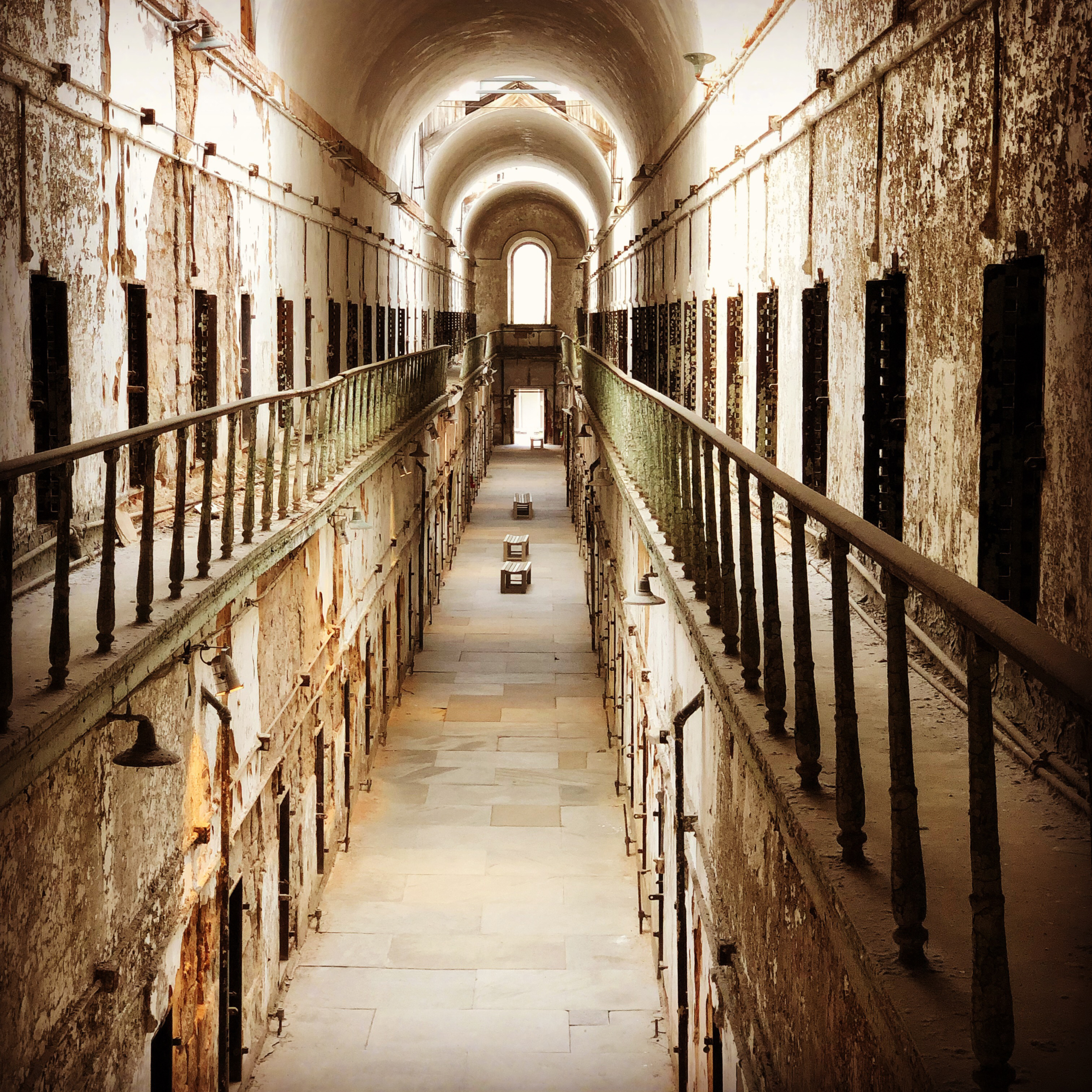
Eastern State’s present condition contributes heavily to its paranormal reputation. It is preserved as a stabilized ruin. Paint peels from walls. Empty cells line cavernous corridors. Sections of the prison remain closed, filled with the debris of decades of abandonment. The structure displays the effects of time instead of concealing them behind a polished restoration.
Visitors have reported whispers, footsteps, shadowy forms, and the sensation of being watched. The building has appeared in paranormal investigations, films, and Halloween programming, securing its place in American haunted culture.
Yet calling Eastern State haunted can flatten its history if the search for spirits becomes more important than the people who were confined there. The institution’s most disturbing legacy is not supernatural. Eastern State demonstrates how reform can reproduce cruelty when a theory is imposed without sufficient regard for human needs.
Its founders believed isolation could heal. Prisoners experienced the consequences when that belief proved dangerously incomplete.
That history also extends beyond the prison’s original experiment. Children were incarcerated at Eastern State alongside adults. Punishment cells continued the use of severe isolation in later decades. Overcrowding created new forms of danger after the system deteriorated.
The empty corridors are frightening because their purpose is still legible. Every door, peephole and sightline records an attempt to control a human being. The architecture does not require a visible ghost to communicate what occurred there.
What We Mean When We Say “Haunted”
A ghost story is rarely only about whether a spirit exists.
It is also about memory, power, and whose suffering receives attention. Pennsylvania’s best-known haunted places are filled with people who once had very little control over how their stories were recorded.
Prisoners appear in institutional files. Poorhouse residents become entries in county records. Soldiers are gathered into casualty totals. Workers accused of violence are remembered through the accounts of the companies that opposed them.
Ghost lore pushes against that reduction, although imperfectly. It returns names and personalities to people history categorized. It keeps disputed events open to examination. It transforms buildings from passive landmarks into places where the past appears capable of answering back.
There are risks in that transformation. Real suffering can become atmosphere. Institutions associated with poverty, disability, incarceration, or death can be reduced to thrilling backdrops. A person’s life can disappear behind a marketable paranormal character.
The difference lies in how the story is told.
Haunted history is at its strongest when the ghost serves as an entrance rather than the entire attraction. The report of a moving quilt should lead to the woman who donated it. A handprint should open a conversation about labor, immigration, and corporate power. A battlefield apparition should direct attention to the war, its causes, and the community left to care for its dead.
Pennsylvania’s ghost stories endure because they address histories that do not feel finished. The buildings remain. The questions remain.
And in several cases, the social conditions beneath the stories remain as well.
Belief in the paranormal is optional. Attention to the lives behind the legends should not be.