 Ashley Elle
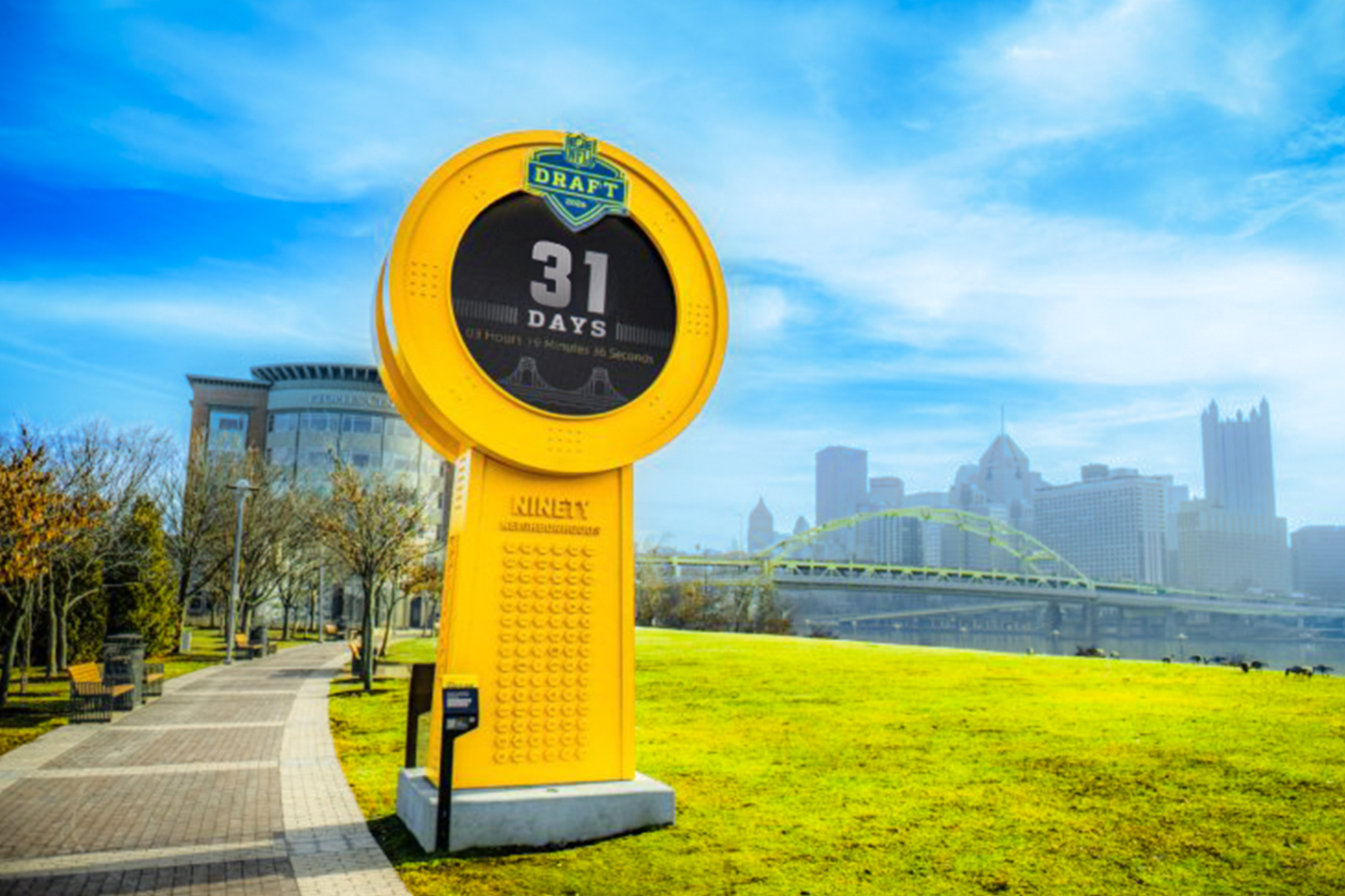
Weeks before the first pick of the 2026 NFL Draft is announced, Pittsburgh is already changing.
Traffic patterns have shifted; barricades have appeared along the North Shore; and temporary fencing surrounds Acrisure Stadium. At Point State Park, where the rivers meet, the grass will soon disappear beneath staging, screens, and hundreds of thousands of fans.
For three days in April 2026, Pittsburgh will become the center of the football world.
City officials estimate hundreds of thousands of visitors will descend on the city – more people than live in Pittsburgh itself – making it the largest event the region has ever hosted.
This isn’t just a weekend event. This is a regional operation. It affects transportation, schools, police, businesses – everything.
But behind the excitement, the banners, and the national television coverage, another story is unfolding, one about logistics, money, disruption, and a city trying to balance pride with reality.
To understand why this matters so much here, you have to understand Pittsburgh. This is not a city that treats football like entertainment. Football here is inheritance. It’s passed down like recipes and last names and union stories.
The Pittsburgh Steelers are not just a team; they are a civic identity. The mythology of Pittsburgh – hard work, loyalty, toughness – is tied directly to the team’s history. In other cities, fans talk about players. In Pittsburgh, people talk about eras.
“My grandfather talked about the Steel Curtain like he knew them personally,” says a fan who asked to remain anonymous. “My dad talks about the Super Bowls. My kids talk about the draft and fantasy football. It’s all connected.”
That connection is exactly why the NFL wanted Pittsburgh. The draft has evolved into one of the league’s biggest traveling events: part fan festival, part television production, part economic engine.
And Pittsburgh offers something few cities can: a dramatic riverfront setting, a walkable downtown, iconic bridges, and a fan base that already treats football like a religious experience.
From a broadcast perspective, the city is tailor-made for an event like this. From a logistics perspective, it’s far more complicated. The public will see a stage, a crowd, and a television show. What they won’t see is the planning operation that began long before, involving city officials, public safety departments, transportation agencies, tourism bureaus, business owners, and event planners.
The draft footprint will be a “split campus,” stretching from Acrisure Stadium across the riverfront toward Point State Park, creating a massive pedestrian zone that will reshape how people move through the city for nearly a week. Road closures will ripple across downtown and the North Shore. Parking will be limited. Deliveries will be rerouted. Police presence will increase. Emergency services will operate under special protocols. Even the Pittsburgh City School District has scheduled remote learning days due to traffic and safety concerns, a reminder that an event like this reaches into everyday life in ways most people don’t initially realize.
Planning for an event of this size is an enormous undertaking. Security coordination alone involves local, state, and federal agencies. Crowd control models, evacuation routes, weather contingencies, medical response teams, transportation plans, and infrastructure adjustments are mapped out months in advance. It is part festival, part construction project, part security operation, and part live television production all happening at once.
And yet, despite the complexity, cities compete aggressively to host events like the NFL Draft. The reason is simple: attention. For a few days, Pittsburgh will be shown on national television over and over again: aerial shots of the rivers, skyline views at sunset, bridges lit up at night, crowds packed along the riverfront. It’s the kind of exposure that cities spend decades trying to create through marketing campaigns, tourism initiatives, and redevelopment projects.
Every major event like this comes with a promise: economic impact. Hotels fill up. Restaurants get crowded. Bars stay open late. Merchandise sells. Ride shares surge. The city appears on national television for days. For many businesses, especially those near the event footprint, this could be one of the busiest and most profitable weekends they’ve seen in years. For the tourism industry, it’s exposure that would otherwise cost millions of dollars in advertising.
But behind the headlines about economic boosts lies a quieter, more complicated conversation. How much does it cost to host? Who pays? Who benefits? Those questions are always more complicated than press releases.
Large events often require public spending on infrastructure, police overtime, sanitation, and transportation adjustments, costs that are not always obvious to residents. Meanwhile, the businesses that benefit most are often concentrated near the event itself: North Shore bars, downtown hotels, and restaurants along the rivers. Some neighborhoods may see a surge in visitors, while others may see regular customers avoid the area because of traffic and congestion.
Some business owners are preparing for their busiest weekend ever, hiring extra staff and expanding inventory in anticipation of the crowds. Others are preparing for a logistical nightmare. For some, the draft will be a major opportunity. For others, it will simply be a complicated week to navigate. Both experiences can exist at the same time.
There is also something harder to measure than hotel bookings and restaurant sales: civic pride. Cities often talk about economic impact because it can be measured in numbers, but events like this also create moments that shape how residents feel about where they live. For a few days, Pittsburgh won’t be a city people overlook or underestimate. It will be the center of the football world.
For all the planning documents and economic projections, the real story of the draft will be personal. It will be the bartender working long shifts. The police officer on crowd duty. The hotel staff working at full capacity. The family renting out their house for the weekend. The small business owner hoping for a strong few days. The kid seeing the draft in person for the first time. The lifelong Steelers fan who can’t believe it’s happening here.
Again and again, the same sentiment comes up: this is Pittsburgh being seen. For decades, Pittsburgh has been reinventing itself. Each generation has watched the city change and redefine itself. Hosting the NFL Draft is another chapter in that story, another moment when the national spotlight lands here and stays for a while. It’s an opportunity for the country to see Pittsburgh not just as it was, but as it is now.
It’s also a reminder of how far the city has come. A few decades ago, Pittsburgh was a city trying to recover from industrial collapse and population loss. Now it is hosting one of the largest televised sporting events in the country. That transformation didn’t happen overnight, and events like this serve as visible milestones in that long story of reinvention.
Every major event comes with a question that rarely appears on banners or billboards: Is it worth it?
The answer depends on who you ask.
To a hotel owner, it might be the best weekend in years. To a restaurant near the stadium, it might be record-breaking sales. To a commuter stuck in traffic, it might be a nightmare. To a resident who leaves town for the weekend, it might be an inconvenience. To a city leader, it might be a global advertisement you can’t buy. To a kid wearing a Steelers jersey in the crowd, it might be unforgettable.
To Pittsburgh, it will probably be all of those things at once.
When the broadcast begins, millions of people will see Pittsburgh the way the city wants to be seen: bridges glowing at night, rivers reflecting the skyline, fans waving Terrible Towels, the stage rising between stadium and city. They will talk about Pittsburgh’s history, its toughness, its reinvention, and its loyalty to football.
What they won’t see are the planning meetings, the budget debates, the traffic maps, the long shifts, the small businesses hoping for a good weekend, and the residents adjusting their routines for a few days. They will see the show. But the story will always be bigger than the show.
In football, when a team is on the clock, the spotlight narrows. The decision matters. The future is about to change. In April 2026, Pittsburgh will be on the clock.
The city will be on display: its infrastructure, its people, its businesses, its culture, and its love of football. The draft will come and go in three days. The stage will come down. The crowds will leave. The streets will reopen. Life will go back to normal.
And then the real question will remain: What did it mean for Pittsburgh?
Was it an economic boost? A logistical headache? A national showcase? A football pilgrimage? A civic milestone?
Most likely, it will be remembered as something more complicated and more Pittsburgh than any headline could capture: a city proud, stressed, excited, inconvenienced, energized, and on display. A football city that, for one weekend, became the center of the football world.
And whether the draft ultimately makes or costs money, whether it’s smooth or chaotic, whether every plan works or some fall apart, the real impact of the weekend probably won’t show up in a budget report.
It will show up in how the city looks on television, how the crowds fill the riverfront, how the bridges light up at night, and how Pittsburgh introduces itself to the country – again.
For one memorable, inconvenient, complicated, exhilarating weekend, Pittsburgh gets to prove itself.